
Time-Sensitive Networking (TSN) is a family of IEEE 802.1 standards which has long been used in industrial automation and the automotive industry. Thanks to the wide availability of components which help avoid vendor lock-in and its deterministic properties, TSN is also considered a fit for more safety- and mission-critical applications in the aerospace and defense industries. A dedicated IEEE 802.1DP Aerospace profile is available since November 2025 to provide guidance for TSN implementation in these markets.
But as TSN is in early stages of adoption in aerospace and defense, there are still open questions – especially about the implementation in real-world scenarios. To answer them, we sat down for a deep dive on TSN for aerospace and defense with Wolfram Zischka, Senior Product Manager at TTTECH Aerospace. You will learn about the potential of TSN, what it takes to successfully implement TSN end-to-end network configuration and interoperability, and what TTTECH Aerospace can offer as a partner.
Let’s start with where TSN as a communication technology is implemented – the digital data backbone. Why is it such a critical focus area for modern aerospace and defense platforms?
Wolfram Zischka: The digital backbone covers almost all domains on the aircraft/rotorcraft or land vehicle. It needs to be a solid base layer for all future upgrades and extensions, like the foundation of a house. If today you build a house that’s two stories high but are considering an expansion to four or more stories in a couple of years, you wouldn’t want to have to tear down and rebuild the house from scratch. When the time comes, you would rather use the existing foundation and build upon it.
The same is true for the digital backbone – it needs to be robust and scalable to accommodate not only the functionalities in use today but also those you may want to include tomorrow or the day after.
What new capabilities are customers looking to support that traditional system architectures struggle to accommodate?
Wolfram Zischka: There’s a trend in the aerospace and defense markets towards more software-defined, AI-enabled, and continuously upgradable platforms. To implement these, systems need to be able to handle a huge amount of data with different real-time requirements from sensors, cameras, and other devices which are a must for AI-powered environment perception, and decision-making, but also lifecycle updates. The combination of very high bandwidth, data rates, and real-time properties are therefore a huge issue for traditional architectures, as those were designed to connect a defined set of sub-systems. Networking technology has to provide a base that allows for high data throughputs mixed with real-time properties and open, extendable architectures.
TSN has emerged as a leading technology for next-generation digital backbones in aerospace and defense applications. What are the key properties that make it such a great fit for modern avionics platforms?
Wolfram Zischka: As mentioned before, modern mission systems and avionics need to accommodate high data rates and for this, Ethernet is becoming the preferred option. As a ubiquitous technology, it is easy to implement. However, standard Ethernet only provides best-effort data transmission that gives no guarantees for data being reliably transferred – and that’s an issue for cases with higher safety and criticality levels. When it comes to aerospace and defense, you want to be very sure the network will always fulfil its role, regardless of circumstances. That means you need a quality-of-service layer that can provide that – an example for that is ARINC 664 part 7 for bandwidth guarantees, another is TSN. Both are Ethernet-based, so they can use that technology environment and ecosystem, while they enhance Ethernet with transmission guarantees.
What makes TSN particularly interesting for aerospace and defense use cases is its support of high bandwidth and real-time properties. You can see TSN as a big toolbox offering a huge selection of tools. However, since TSN covers a wide range of markets, it provides profiles that cover the specific market requirements, such as the 802.1DP Aerospace profile. 802.1DP specifies the set of tools that best fits aerospace onboard networks and leaves out tools that are not a good fit. This profile needs to be considered when you want to set up an aerospace or defense networking application.
Why do customers choose TSN for their aerospace and defense applications?
Wolfram Zischka: For aerospace and defense, TSN is an evolution of Ethernet that provides guarantees with the mechanisms or with the tools listed. That means that Ethernet already inherently supports the mechanisms required to enable real-time properties. Its wider application is driven by market actors like the US Department of Defense, who are looking to avoid vendor lock-in and thus advocate the MOSA (Modular Open Systems Approach). The key topic is ensuring openness for upgrades, extensions, and interoperability.
The Army’s aerial systems and land vehicles typically have very long lifecycles and remain in service for multiple decades. Upgrades are necessary to preserve, add, or improve functionality and to bring older applications to the state-of-the-art. Vendor lock-in can become a huge issue – if companies buy a proprietary system solution from a specific vendor, they need to always go back to that vendor for adjustments. Depending on the application, this may mean that upgrades are more costly or take longer – or it could mean that certain functionalities cannot even be incorporated if they do not fit with that proprietary solution.
MOSA therefore propagates the use of open standards as a key enabler for successful upgradability throughout the lifecycle. TSN was identified as the preferred option for an open network standard for these applications due to the large ecosystem behind it and the guarantees it provides.
You just talked about MOSA, which is a hot topic in the industry. What does a truly MOSA-enabled digital backbone look like in practice?
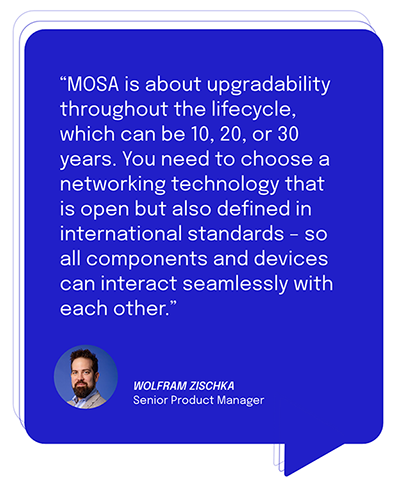
Wolfram Zischka: As mentioned above, MOSA is about upgradability throughout the lifecycle. The benefit in an open system is that you can unite devices from different vendors.
This allows customers to pick and choose the components that best fit their system and enables them to exchange them, e.g. to enable new functionalities that would not be covered by the existing device. A key topic here is that all devices used within the system need to be interoperable, even if they come from different vendors.
And this is where we are back at the technology level. You need to choose a networking technology that is open but also defined in international standards – so all components and devices are built to the same specifications and can interact seamlessly with each other.
TSN provides guarantees for data transmission in an Ethernet-based network. However, safety-critical aerospace and defense networks have specific requirements in terms of validation, qualification or certification – how can TSN accommodate that?
Wolfram Zischka: This is where it gets interesting – standards in the aerospace and defense industry have a huge impact on the setup of any data network. TSN provides a baseline standard and a toolkit, but it’s up to the user to implement it properly to ensure that the industry’s safety and security standards are met. That means you need to not only look at the design phase or choose devices, but a key topic is also how to integrate all your components in a consistent manner to ensure the network is future-proof and manageable throughout its lifecycle.
Following up on your last comment, what do companies have to consider to successfully set up, configure, and manage TSN networks for example in MOSA architectures?
Wolfram Zischka: There are several important steps on the component, certification, and integration levels.
The first step is finding and selecting the components needed to set up the network. That seems easy enough – as we mentioned, there are a lot of options available on the market – you could for example, select automotive ASICs that are available in large quantities and at low cost. However, you must make sure that the devices you choose comply with the TSN aerospace profile, so that they can serve and support all the tools selected from the TSN toolbox.
The second step is to make sure the components can meet the targeted certification level for your application. This depends on the functions that the network needs to support and – again – it can be easy, if you have the evidence that your TSN device fits the required design assurance. Let me give you an example – for older processors, you need to have a certain equipment design and prove requirements-based testing. You need traceability between high-level and low-level requirements, verification cases, unit tests, and all the things defined in the DO-standards. Ideally, you have a partner who can deliver this for you. That’s important, for example if you want to use automotive ASICs. They are designed to different industry standards, so they might not be a fit for certain aerospace-related requirements.
The third step is, I think, the most crucial and therefore should get more attention: the integration of components into a complete system. Because for a network, one component isn’t sufficient – you need to connect many different computers and devices, often from different vendors. Typically, you’ll use TSN switches for this – and you’ll need a means to configure all of them consistently across the entire network. In addition, you need to be able to load the devices for a specific mission or a specific aircraft and ensure frequent updates with new data are possible across the system’s lifetime, so you can add capabilities and functionalities over time.
TTTECH has a lot of cross-industry experience, being active in the aviation, space, defense, industrial automation, and mobile machinery sectors. What cross-industry lessons are most valuable for digital backbones for aerospace and defense programs?
Wolfram Zischka: One lesson you learn from working across domains is that while certain key topics are relevant across a range of industries – such as the increased use of autonomy and AI-enhanced applications, it is also important to remember that every industry is different and that the same standards do not apply to all.
Universally, it’s about building networks for reliable data transmission, but how they are designed, and the specific requirements for their components will differ – just think about a tractor, which can stop on the field at any time, versus an airplane that needs to be fail-operational, or components sent to space that must be able to withstand a wide range of temperatures as well as radiation over 15 years or more.
What I think is crucial though is having the technological expertise, as well as integration and certification/qualification know-how. You acquire that over many years designing, building, and certifying data networks. That is something TTTECH can bring to the table.
What role does TTTECH Aerospace play in making digital backbones and systems architectures open, scalable, and mission-ready?
Wolfram Zischka: TTTECH Aerospace is part of TTTech Systems SE, a complete solutions provider leveraging more than 25 years of certification and integration experience in aerospace. Our core competence is Ethernet-based, safety-critical avionics networks for systems supporting functions of varying criticality levels.
Our product portfolio covers a range of technologies and applications to fit customers’ requirements. We provide certifiable networking elements, network technology know-how, and network tooling supporting the integration.
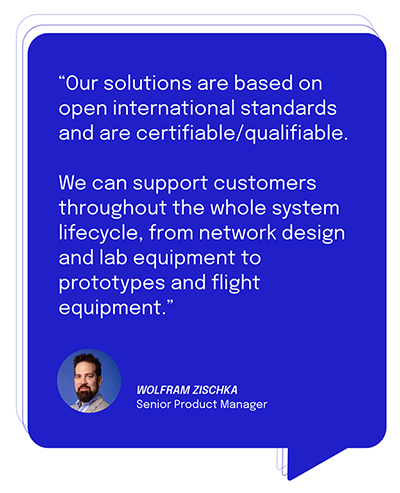
A key proposition we have is that all our solutions are based on open international standards and are certifiable/qualifiable. This means they are interoperable, scalable, and comply with the highest safety and security standards in the aerospace and defense sectors. In addition, we can support customers throughout the whole system lifecycle, from network design to lab equipment, prototypes, and flight equipment.
What products and services does TTTECH Aerospace offer for TSN networking applications in aerospace and defense?
Wolfram Zischka: What's important for customers is to have a partner that provides components fulfilling not only the current but also future requirements for certification. That is essential to ensure the components fit into current systems as well as into those that customers are going to require in ten or twenty years’ time.
We know TSN as a technology very well, we have a selection of products that comply with the 802.1DP Aerospace profile, and we have a wealth of implementation experience across industries. That can be an asset for customers, since few suppliers on the market offer integration support for TSN.
There are a lot of similar TSN components on the market, but there's not a lot of know-how or capability on the side of networking and network integration. It can be very cumbersome to consistently configure 10, 15, or 20 devices within a unified network. And that's exactly what we at TTTECH Aerospace can provide. We've been working in the TSN environment since 2012 in different markets.
Most recently, TTTECH North America has been selected to provide the deterministic Ethernet-based digital backbone for the U.S. Army’s High Accuracy Detection and Exploitation System (HADES), delivering a 10 Gigabit Time-Sensitive Networking (TSN) platform, including TSN switches, endpoints, and network management software. These enable secure, low-latency, and upgradeable mission-critical communications for this key aerial intelligence, surveillance, and reconnaissance (ISR) program.
TTTECH Aerospace’s TSN expertise is leveraged in our products – for example, we offer network integration tooling that takes the heavy lifting. Customers only need to set the configuration at the network level, i.e. they decide what data flows are needed, and then our planning and configuration tool Slate XNS supports the low-level device confirmation.
Thank you very much, Wolfram, for these insights.
TTTECH has been actively involved in shaping the TSN standards for industrial automation and has long experience with their applications both in industrial and automative use cases. We support customers and network integrators throughout the whole process – from defining needs to providing components and tooling for network modelling, to consultancy.
Find out how we can help future-proof your platforms as mission requirements continue to evolve.
Check out our TSN offering
- Slate XNS – planning and configuration tool for TSN networks
- TSNEnd Point Lab (PCIe) – evaluation and development of systems requiring deterministic networking and high reliability
- TSNEnd Point IP Integration Kit - ready-to-use integration examples for the TSNEnd Point chip IP for evaluation or development
- Technical TSN trainings
