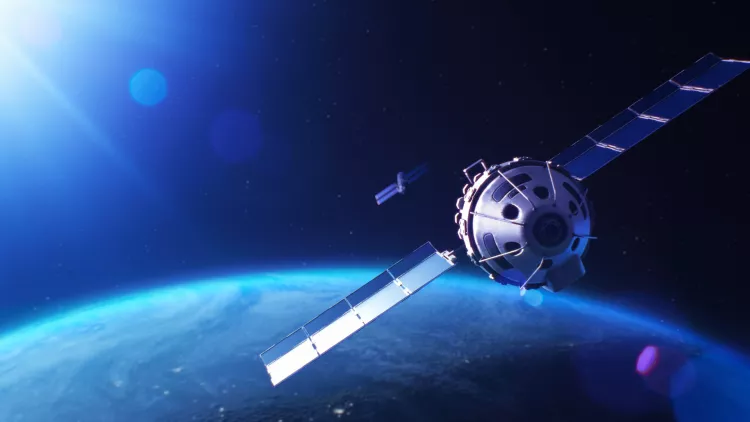
For the first time in more than half a century, humans have traveled beyond low- Earth orbit and returned safely from lunar space.
NASA’s Artemis II mission marks the first crewed journey around the Moon since the Apollo era. Over ten days, the Orion spacecraft completed a lunar flyby and safely returned to Earth - traveling farther from our planet than any humans before, and reaching a maximum distance of 406,771 km from Earth.
Artemis II was not about landing on the Moon. Its purpose was more fundamental: to prove that the Orion spacecraft - and the systems within it - can carry humans into deep space and back under real mission conditions. From deep-space operations and communications to power, thermal control, and guidance, the spacecraft was tested across a complete lunar mission profile.
What sets Artemis II apart is not only the distance traveled but the consistency with which Orion’s systems performed across every mission phase. From launch to lunar flyby and return, the spacecraft behaved exactly as designed - a result of deliberate architectural choices, including deterministic, time‑synchronized communication. As a long-term technology partner on Orion’s avionics network, TTTECH has helped enable a system architecture in which critical functions operate predictably and independently, even in the most demanding environments.
For Todd Smithgall, Senior Customer Solution Architect at TTTECH, who has been closely involved in the development of Orion’s avionics architecture for many years, Artemis II represents the visible outcome of principles that have shaped his entire career.
“When everything works perfectly,” Todd says, “you never hear a word about the avionics system. And that’s exactly how it should be.”
This is the story of how deterministic communication became a foundational enabler for Orion’s data network - and why these same principles matter far beyond a single mission. At the heart of this deterministic approach is Time‑Triggered Ethernet - a standards‑based deterministic form of Ethernet networking in which all systems share a common notion of time. By transmitting critical data according to a predefined schedule, fully predictable, real‑time communication over standard IEEE 802.3 Ethernet is enabled - an essential requirement for safety-critical systems such as human-rated spacecraft.
Read more:
Know-how: Deterministic networking for safety-critical systems
Todd Smithgall on the role of Time Triggered Ethernet in Orion’s avionics architecture
Todd, you have been working in crewed space programs for more than four decades. How did your career in human spaceflight begin?
My career in manned space computing systems began in 1984 on the Space Shuttle program. At the time, I worked for IBM, which held the contract to upgrade the Shuttle’s flight control computers - replacing the original systems with new computers that were faster, lighter, and consumed less power.
That project gave me early exposure to the complexity and cost of fault‑tolerant, time‑synchronized systems. Everything - communication, synchronization, input/output services, and application software - was tightly intertwined. A change in one place caused major changes elsewhere, often at great expense. Those lessons shaped my entire professional career.
What were the main challenges of spacecraft avionics in the Space Shuttle era?
The biggest challenge was tight coupling. Fault tolerance, synchronization, communication, and application software were all bound together in the same flight software.
At one point, we were asked to send just thirty-two additional data words from the flight computers to the crew displays. The cost estimate came back at around 105 million dollars. That had nothing to do with the data itself - it showed how difficult it was to change a tightly coupled system. Entire teams were dedicated solely to tracking low‑level timing and input‑output behavior.
You often say Time‑Triggered Ethernet was a turning point for you. What did you see in it - and why does determinism matter?
When I first learned about Time‑Triggered Ethernet, it was immediately clear to me that it solved a problem the Space Shuttle program had struggled with for decades.
The main benefit is determinism. You control how the system behaves down to the microsecond, and that behavior is independent of the application software. The interface between applications and the communications network is perfectly defined, well understood, and fully controlled. That separation simply did not exist in earlier systems.
From your point of view, how did these principles influence the Orion program?
When I transitioned to work on Orion at Honeywell Aerospace in 2006, Time‑Triggered Ethernet had not yet been selected. Honeywell and TTTECH were already collaborating on the technology for space, but it wasn’t a given that Orion would adopt it.
I made it my personal mission to convince people at Honeywell, then at Lockheed Martin, and ultimately at NASA that Time‑Triggered Ethernet was the right way to build a modern exploration vehicle. At the time, the technology was still under development, so the development had to be accelerated. Honeywell built space‑qualified ASICs using TTTECH intellectual property, and the decision was ultimately made to deploy Time‑Triggered Ethernet in Orion.
What role does Time‑Triggered Ethernet play inside Orion today?
Every display, every control input, every thruster firing — every bit of data inside the vehicle travels across the Time‑Triggered Ethernet network.
And the good news is that we never hear a word about the avionics system or the network. It’s performing exactly as intended. The crew never has to think about it. It just works.
What makes Orion fundamentally different from other human spacecraft?
Orion is the only crewed vehicle in existence today - and the only vehicle since the Apollo program – designed to survive re‑entry from lunar orbit. The speeds are extreme, the temperatures are enormous, and the forces are intense. The control system that keeps Orion stable and properly oriented during re‑entry is entirely based around Time‑Triggered Ethernet. Without it, the vehicle would be uncontrollable and simply wouldn’t work.
Orion was originally called the Multi‑Purpose Crew Vehicle. What does that tell us about long‑term space programs?
The MPCV was eventually renamed Orion, and today it’s in space, returning humans from the Moon. My advice to younger engineers is not to worry too much about program pauses, name changes, or shifting priorities. Keep doing the work. Be patient. Future instructions will come - and things often work out in the end, even if it takes longer than expected.
Read more:
TTTECH Aerospace Human and robotic exploration
Looking beyond Artemis II, where do you see these technologies becoming even more important?
They become even more critical for modular Moon bases - especially when modules are built by different companies, organizations, or nations. In those cases, interfaces must be perfectly well-defined.
Time Triggered Ethernet forces designers to resolve those details early . It makes parties agree on what data needs to be communicated, at what rate, and how the system will behave. It handles science data and communications while simultaneously controlling life- support systems, thermal management, and power systems. There are no do overs on the Moon. That level of rigor is essential for systems expected to operate for decades under radiation exposure and extreme temperature variations.
Finally, how do you personally reflect on being part of a mission like Artemis II?
There’s a mix of emotions-joy in seeing the work succeed, and concern for the crew and their families until everything ends safely. It’s important to remember that no individual builds something like Orion. Thousands of people contributed - at Honeywell Aerospace, at TTTECH, at Lockheed Martin, and at NASA. Many of them aren’t even officially associated with the program anymore. Careers move on, but the work remains.
Programs like this are long-term human endeavors - on the scale of the pyramids. They don’t happen overnight. The impact is huge, and the responsibility is real.
A professor once told us, “I’m going to do everything I can to flunk you, because you’re about to go build the world I have to live in.” I’ve carried that with me throughout my career. What we do
every day matters. Other people’s lives depend on the quality of our work.
Artemis II represents deterministic, reliable data networks make possible. Orion’s performance demonstrates how dedicated individuals, companies, and space agencies working together can enable human exploration beyond low‑Earth orbit. For TTTECH, this mission stands for systems that work exactly as intended - quietly, reliably, and consistently - especially during the mission phases that matter most.
